
Medical Disclaimer: This content is for informational purposes only and does not substitute professional medical advice. If sleep disruption is significantly affecting your daily life, consult a qualified healthcare provider.

Introduction
You’re exhausted. Your body is ready for sleep. But your brain has other plans.
The moment you lie down, thoughts start flooding in. Unfinished tasks, conversations you could have handled better, things you forgot to do, worries about tomorrow. One thought leads to another, and before you know it, an hour has passed—and you’re more alert than when you first got into bed.
If this sounds familiar, you’re not alone—and you’re not broken.
The experience of a brain that won’t shut off at night is one of the most common sleep complaints. And while it feels like a willpower problem, it’s actually a physiological one. Understanding why it happens is the first step toward actually fixing it.
In this article, you’ll learn:
- Why your brain becomes hyperactive at night
- The specific nervous system state behind racing thoughts
- What actually helps—practical strategies you can use tonight
- What tends to make it worse (some of these may surprise you)
Why Your Brain Won’t Turn Off: What’s Actually Happening
When you finally stop moving—no screens, no tasks, no distractions—your brain doesn’t suddenly go quiet. In fact, for many people, it does the opposite.
Here’s why.
Your Nervous System Is Still in Activation Mode
Your autonomic nervous system has two main modes:
- Sympathetic (fight-or-flight): Alert, activated, scanning for problems
- Parasympathetic (rest-and-digest): Calm, recovered, ready to rest
Sleep requires your system to shift into parasympathetic dominance. However, if you’ve spent the entire day in sympathetic overdrive—responding to emails, managing stress, rushing through tasks—your nervous system doesn’t automatically flip a switch at bedtime.
The shift from activation to rest takes time. And if you go from high stimulation straight to lying in the dark, your brain often interprets the sudden quiet as a signal to review everything that happened. That’s the mental replay you experience as racing thoughts.
Cortisol and the Timing Problem
Cortisol is your primary stress hormone. Under normal circumstances, it follows a natural rhythm: highest in the morning to help you wake up, gradually declining throughout the day, reaching its lowest point at night to allow sleep.
However, chronic stress, irregular schedules, and evening stimulation—including blue light from screens—can disrupt this rhythm. When cortisol remains elevated into the evening, your brain stays in a low-grade state of alertness.
As a result, even when you feel physically tired, your mind keeps running.
The Default Mode Network Activates
Neuroscience research has identified a network of brain regions that becomes highly active when you’re not focused on an external task. This is called the default mode network (DMN)—and it’s responsible for self-referential thinking, mental time travel, and what most people recognize as rumination.
When external stimulation drops off at night, the DMN kicks in. For people already under stress or with an overactive nervous system, this internal chatter becomes particularly loud.
If this pattern sounds familiar beyond just bedtime, our article on overthinking and anxiety explores why your brain gets stuck in loops—and how to interrupt the cycle.
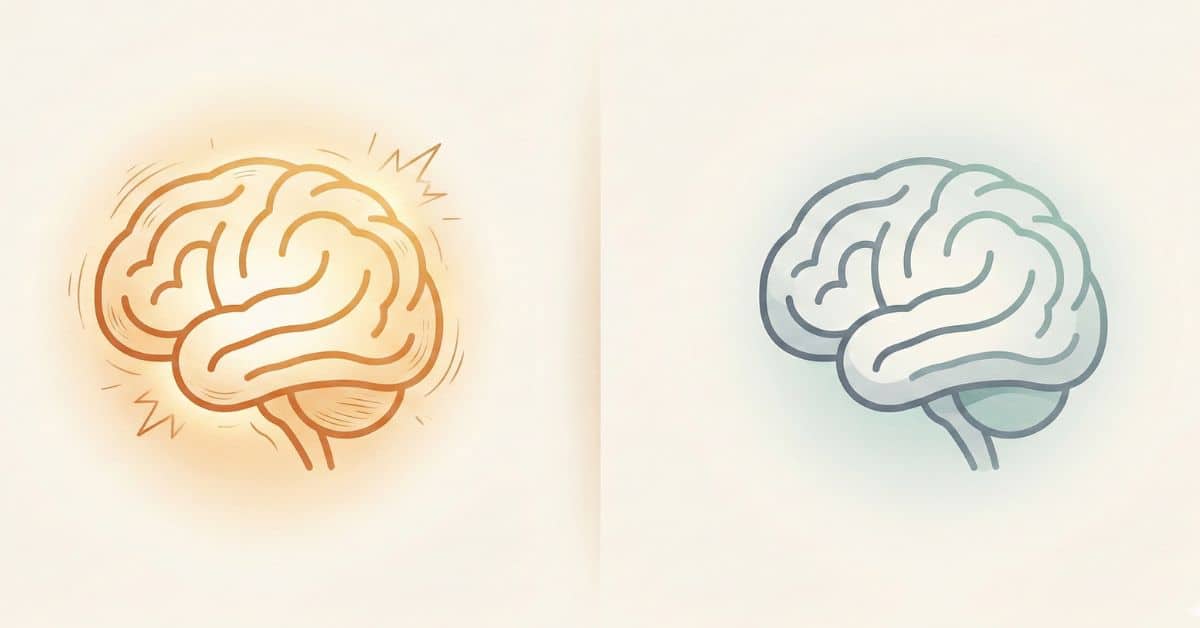
In short: your brain isn’t malfunctioning. It’s doing exactly what a stressed, understimulated-all-at-once nervous system does.
What Actually Helps (Tonight)
Understanding the cause is useful. But you also need practical tools. These strategies work by targeting the root mechanism—nervous system activation—rather than just masking symptoms.
1. Do a Brain Dump Before Bed
One of the most effective—and underused—techniques is simple: write everything down before you try to sleep.
Set a timer for 5-10 minutes. Grab a notebook and write every thought, task, worry, or idea that’s in your head. No structure required. Just get it out of your mind and onto the page.
Research from Experimental Brain Research (2018) found that writing a to-do list before bed—specifically tasks for the next day—helped participants fall asleep significantly faster than journaling about completed tasks. Sleep researchers suggest the act of externalizing the mental load reduces activation in planning-related brain areas, effectively giving the mind “permission” to stop processing.
How to do it tonight:
- Sit somewhere quiet, not in bed
- Write everything on your mind—tasks, worries, random thoughts
- For each worry you can’t solve tonight, write: “Not tonight. Tomorrow.”
- Close the notebook. Signal to your brain that it’s done for the day.
2. Cool Down Your Nervous System First (Don’t Skip This)
Most people try to fall asleep while still in full activation mode. Then they wonder why it doesn’t work.
Your body needs a transition period. The goal is to actively shift your nervous system from sympathetic to parasympathetic before you get into bed.
Effective methods:
Physiological Sigh: Inhale deeply through the nose, then take a second shorter sniff at the top to fully inflate the lungs. Exhale slowly through the mouth. Repeat 2-3 times. Research from Stanford neuroscience suggests this specific breathing pattern is one of the fastest ways to reduce physiological arousal—faster, in fact, than standard deep breathing.
Box Breathing (4-4-4-4): Inhale for 4 counts, hold for 4, exhale for 4, hold for 4. Do this for 3-4 cycles. It’s simple, it works, and it takes under 2 minutes. If you want to go deeper, our guide on breathwork for mental clarity covers several science-backed techniques in detail.
Progressive Muscle Relaxation: Systematically tense and release muscle groups from feet to head. This activates the parasympathetic system and reduces physical tension you may not realize you’re carrying.
The key principle: don’t wait until you’re in bed to start calming down. Begin the transition 20-30 minutes before you want to sleep.
3. Create a Hard Stop for Stimulation
Your brain needs a wind-down window. Without one, you’re asking it to go from 100 to 0 instantly—which rarely works.
Identify a time each evening to stop:
- Work and email — at least 90 minutes before bed
- Screens and bright light — at least 30-60 minutes before bed
- News and social media — these are particularly activating because they’re designed to provoke emotional responses
This isn’t about being rigid. It’s about acknowledging that your nervous system needs time to decompress, just like your body needs time to cool down after exercise.
Replace with: reading physical books, light stretching, a warm shower, calm conversation, or listening to music without lyrics.
4. Address the Thoughts Directly (Don’t Fight Them)
Here’s a counterintuitive principle: trying not to think about something often makes you think about it more.
This is called the rebound effect, and it’s well-documented in psychological research. The harder you try to suppress a thought, the more your brain monitors for it—keeping it active.
Instead, try these approaches:
Cognitive defusion: Instead of engaging with the thought, observe it. “There’s that thought about the meeting again.” Label it, then let it pass without analyzing it.
Scheduled worry time: Choose a 10-minute window during the day for intentional worrying. When a worry appears at night, remind yourself: “I’ll think about that during my worry time tomorrow.” This trains your brain that there’s a designated time for those thoughts—and it’s not now.
Replace, don’t resist: Give your brain something mild to focus on. Counting backward from 300 by threes, visualizing a familiar route, or doing a slow body scan all gently occupy the analytical mind without stimulating it further.
5. Check What You’re Doing in the Last 2 Hours of the Day
Sometimes a brain that won’t turn off at night is responding to something obvious—but you haven’t connected the dots yet.
Common activating habits people miss:
- Caffeine after 2pm — caffeine has a half-life of 5-7 hours. A 3pm coffee still has a significant presence in your system at 9pm.
- Intense exercise late at night — exercise raises cortisol and body temperature, both of which need time to normalize
- Heavy meals close to bedtime — digestion is metabolically active and can disrupt the rest state
- Alcohol as a “wind-down” — alcohol may help you fall asleep initially, but it disrupts sleep architecture in the second half of the night, causing lighter, more fragmented sleep and often early waking with alert-mind symptoms
Adjusting even one of these may produce noticeable results within a few days.
What Doesn’t Actually Help (Despite Being Popular)
Counting Sheep
Passive distraction techniques that don’t engage the mind sufficiently tend to fail. Counting sheep is boring enough that your brain wanders back to thoughts almost immediately.
Checking Your Phone “Just for a Minute”
Blue light suppresses melatonin—and if you’re curious whether taking a supplement actually helps, our article on whether melatonin really works breaks down the evidence. But more importantly, any interaction with information—messages, social feeds, news—re-engages your alerting network. Even mildly interesting content can reset the process you spent the last hour building.
Lying in Bed Trying Harder
The longer you lie awake frustrated, the more your brain associates your bed with wakefulness and anxiety. If you’ve been awake for more than 20-25 minutes, get up. Do something calm in low light until you feel genuinely sleepy, then return. This preserves the mental association between bed and sleep.
When It’s More Than Just a Busy Brain
For many people, a brain that won’t turn off at night is a stress and nervous system regulation issue—and the strategies above will make a meaningful difference. If you’re unsure whether your nervous system is simply overactivated or something more, our article on signs your nervous system is dysregulated can help you tell the difference.
However, persistent racing thoughts at bedtime may also be connected to:
- Anxiety disorders — where ruminative thinking is a core symptom
- ADHD — executive function challenges often show up most clearly at night when structure falls away
- Perimenopause or hormonal shifts — sleep disruption and intrusive thoughts are common symptoms
- Thyroid imbalances — can elevate nighttime arousal
- Mood disorders — racing or intrusive thoughts may warrant professional evaluation
If sleep disruption is frequent, prolonged, or significantly affecting your daily functioning, speak with a healthcare provider. What feels like “just stress” sometimes has a treatable underlying component.
A Simple Wind-Down Routine You Can Start Tonight
You don’t need a perfect evening routine. Start with this:
60 minutes before bed:
- Stop work and screens
- Do a 5-minute brain dump (notebook, not phone)
- Dim the lights in your space
30 minutes before bed:
- Do 3-5 minutes of breathing or gentle stretching (see our nervous system regulation exercises for guided options)
- Light reading or calm activity (nothing stimulating)
In bed:
- If thoughts appear, observe them without engaging
- Use box breathing or body scan if needed
- If still awake after 20-25 minutes, get up briefly
The goal isn’t perfection. The goal is to give your nervous system a consistent signal that the day is over.

Frequently Asked Questions
Why does my brain get more active at night?
During the day, external tasks and stimulation keep your brain occupied. At night, when those distractions disappear, your default mode network activates—the system responsible for self-referential thinking and mental replay. At the same time, if your cortisol levels haven’t fully dropped, your nervous system remains in a low-grade alert state. The combination of a quiet environment and an activated nervous system creates the perfect condition for racing thoughts.
Is it anxiety or just stress?
Both can cause a brain that won’t turn off at night, and they often overlap. Stress tends to be tied to specific triggers—a deadline, a conflict, a big change. Anxiety is more diffuse: the thoughts keep coming even when there’s nothing concrete to worry about, and the physical sensations (racing heart, chest tension, restlessness) tend to persist. If nighttime overthinking is frequent, intense, or paired with daytime anxiety, it may be worth speaking with a professional.
How long does it take to fix nighttime overthinking?
Most people notice some improvement within a few days of implementing a consistent wind-down routine—particularly the brain dump and the hard stop for stimulation. Deeper changes, like reduced cortisol reactivity and better nervous system regulation, typically take 3-4 weeks of consistent practice. There’s no overnight fix, but the direction is usually clear relatively quickly.
Conclusion
A brain that won’t turn off at night isn’t a character flaw. It’s a nervous system that hasn’t yet received the signal that it’s safe to rest.
The good news is that this signal can be learned—and the strategies above work with your biology rather than against it. Sleep researchers have consistently found that behavioral interventions targeting nervous system regulation outperform passive techniques like counting sheep or white noise alone.
Start with one change tonight. A brain dump before bed, a few minutes of breathing, or simply turning off screens 30 minutes earlier than usual.
If your brain won’t turn off at night, remember: it’s a physiological issue—and physiological issues respond to the right inputs. Small changes, practiced consistently, can make a bigger difference than any single dramatic intervention.
Your brain will quiet down. It just needs the right conditions.
You might also find helpful:
- Overthinking and Anxiety: Why Your Brain Won’t Turn Off (And How to Help It)
- Nervous System Regulation Exercises: Simple Ways to Feel Calmer and More Balanced
- Breathwork for Mental Clarity: Science, Techniques, and Daily Practice
- Does Melatonin Really Work? Facts and Myths About the Sleep Hormone
- How to Calm Anxiety Fast Without Medication
- 5-Minute Anxiety Reset Exercises You Can Do Anywhere
Scientific References:
- Scullin MK, et al. “The Effects of Bedtime Writing on Difficulty Falling Asleep: A Polysomnographic Study Comparing To-Do Lists and Completed Activity Lists.” Experimental Brain Research. 2018;235(6).
- Huberman A. “Tools for Managing Stress and Anxiety.” Huberman Lab Podcast. Stanford Neuroscience, 2021.
- Wegner DM. “Ironic processes of mental control.” Psychological Review. 1994;101(1):34–52.
- Roth T. “Insomnia: Definition, Prevalence, Etiology, and Consequences.” Journal of Clinical Sleep Medicine. 2007;3(5).